OLSS-Heritage-slide11-1280x590.jpg

The chapels

Apart from the main Altar, there are three chapels with altars and also St Joseph's altar in the aisle of the Nave. With many priests in the past, they would have all been saying Mass at their individual altars.

Lady Chapel 

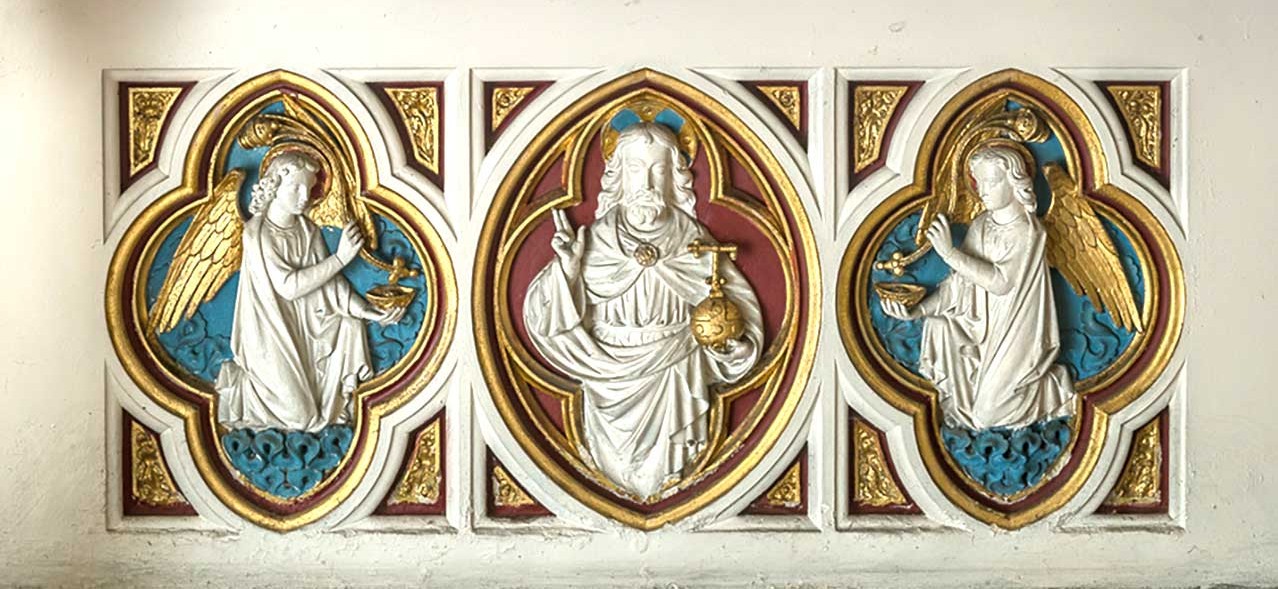
The Lady Chapel was originally dedicated to St Joseph. A large carved reredos shows the Blessed Virgin Mary surrounded by angels and standing on a dragon signifying triumph over evil. A reredos is an ornamental screen covering the wall at the back of an altar. The altar frontal depicts the Annunciation in three roundels between marble columns. 

The room to the left was originally intended for the organ and as oratory for a religious community. The original organ by Gray and Davidson, housed here, was exhibited at The Great Exhibition of 1851 at Crystal Palace. The arcade, to the left of the chapel, was glazed in the 1960s to create a vestry which leads to the sacristy.

To the right, is the tomb chest with an effigy of Canon Richard North, the church's founder with his feet resting on a poodle. It was installed in 1863.

Designed by EW Pugin, Augustus Pugin‘s son, and executed by William Farmer, it is made of the same materials and design as the altar, so the altar could also be by Edward Pugin.

Above the effigy of Canon North is an arch with stops of angels holding the instruments of the Passion. 

Augustus Pugin decorated the chapel's panelled wagon roof. 
blessed_sacrament.jpg

Blessed Sacrament Chapel 

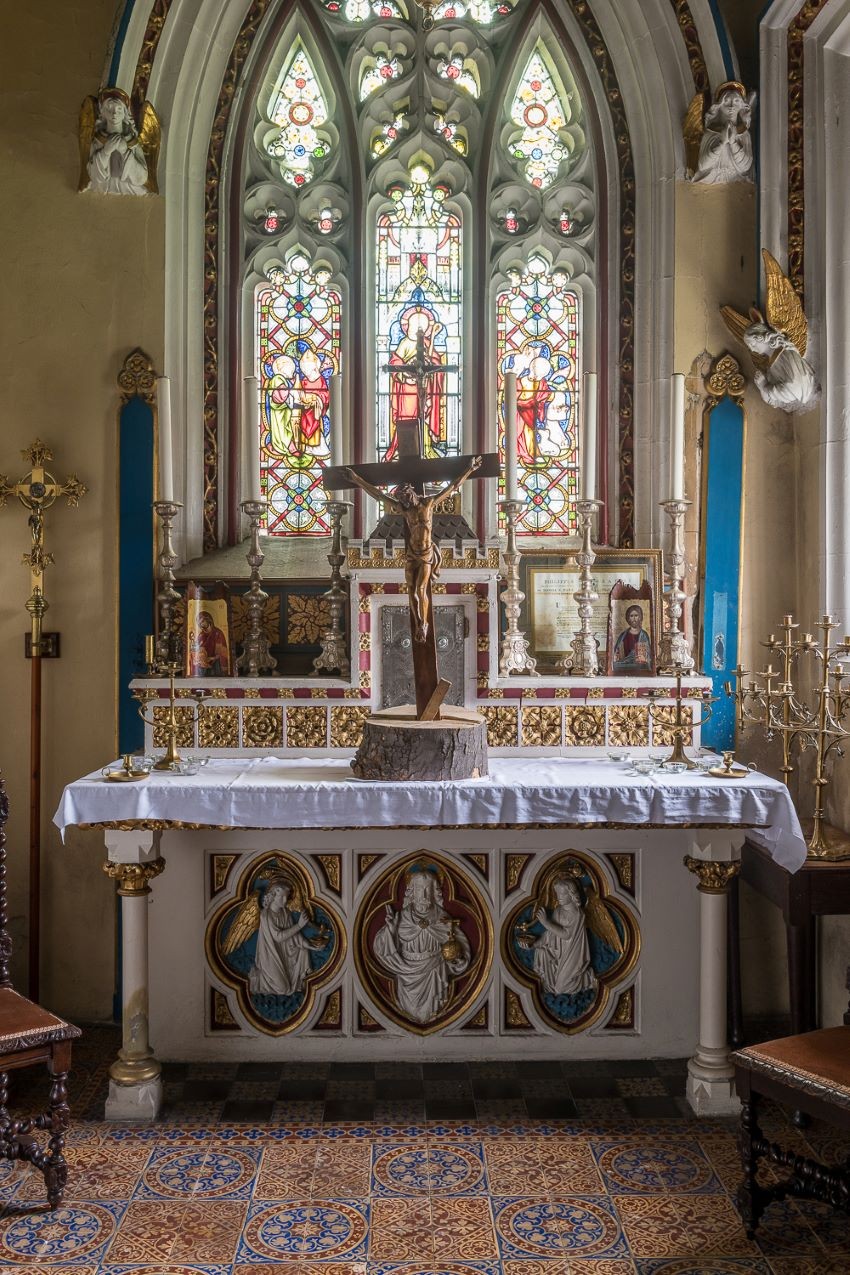
The chapel has wrought-iron gates by John Hardman who worked for and with Pugin extensively, including at the Palace of Westminster. Augustus Pugin had a close working relationship and friendship with John Hardman (a daughter of Pugin married Hardman's nephew). The chapel has a small piscina 

The wagon roof of the chapel springs from a beautifully carved wooden cornice. The stencilled decoration was probably executed by Thomas Early from Pugin’s design. This is decorated with phrases in Latin from the hymn ‘Lauda Sion’. The cedar panels between the ribs and bosses also have stencilled decorations which are all characteristic of Pugin’s work.

Early was an artisan who worked for John Hardman, and in a letter to dated 21 May 1851, he told Hardman that Pugin’s designs for the Chancel ceiling (and probably those of the nave and side aisle) had arrived. “Mr Pugin has sent some most beautiful designs for this job but they will take a deal more gold than I had thought as he has introduced gold where I have never used it before,” he reported. 

Gold crowns

The ceiling cost £35 and took 15 days to paint. However, the ceiling of today is not that which was invoiced for on 31 December 1851. The red background of 1851 appears to have been replaced with off-white, at an unknown time.

It was described as: “Red ground [meaning background] and party coloured border ground powdered with gold stars large gold centres with lamb & banners ’IHS‘ and floriated crosses centres encircled either 8 gold crowns each white lined ribs parcel gilt and coloured 15 bosses gilt and gilding cornice enriched with carved foliage and scriptures ball flowers, small bosses and fillets gilt.”

While Stuart Knill paid for the reredos and altar, the tabernacle was paid for by a less affluent benefactor. However, Knill ordered it. In a letter to Hardman, of 6 August 1850, Pugin complains, “Stuart Knill has ordered the tabernacle for Greenwich but only £20 so it must be very small – I am savage furious and disgusted.” The Altar and tabernacle were designed by Pugin. 

Sacred Heart Chapel

The Sacred Heart Chapel is an extension of 1891. Opening off the aisle, it has its own altar rails of stone and marble. Above a marble frontal with a mosaic Agnus Dei, the Gothic detailed reredos has a central figure of the Sacred Heart, and in the panelled remainder are angels, shields, and much ‘diaper’ work. Diaper originates from a type of linen fabric with a repeating diamond pattern. This fabric, and the pattern itself, became a decorative element in various art forms, particularly in stained glass and stonework. It describes a repeating geometric or floral design, often featuring squares, rectangles or diamonds.  

The chapel was originally intended to be dedicated to Sir Stuart Knill - a first cousin of Augustus Pugin's third wife Jane. 

Sir Stuart Knill lived at the Grange on Croom's Hill, and was only the second Catholic Lord Mayor of London since the Reformation. 
 
EW Pugin (Augustus Pugin's son) had drawn up designs for the Knill chapel, in 1855, they remained unexecuted. 
 
The marble tablet on the left was installed after the First World War, commemorating the parishioners who had died. See past 2017 newsletter containing research on them.  

Following the death of the parish priest Canon Michael O'Halloran in 1921, who completed 61 years of service at the church, a cenotaph with crucifix was installed on the west side. 

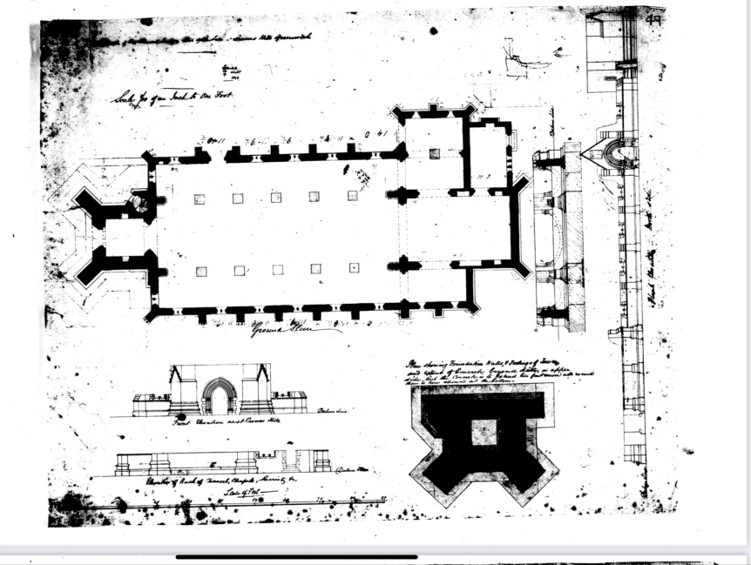
As can be seen from Wardell’s ground plan below, the chapel was not part of his original design.

Wardell Archive, State Library of New South Wales.  Ground plan

Wardell Archive, State Library of New South Wales. Ground plan.

Sacred Heart Altar
Sacred Heart Altar
Sacred Heart Chapel Cenotaph
detail of the Lady chapel reredos

Read about our restoration project