The exterior
The church
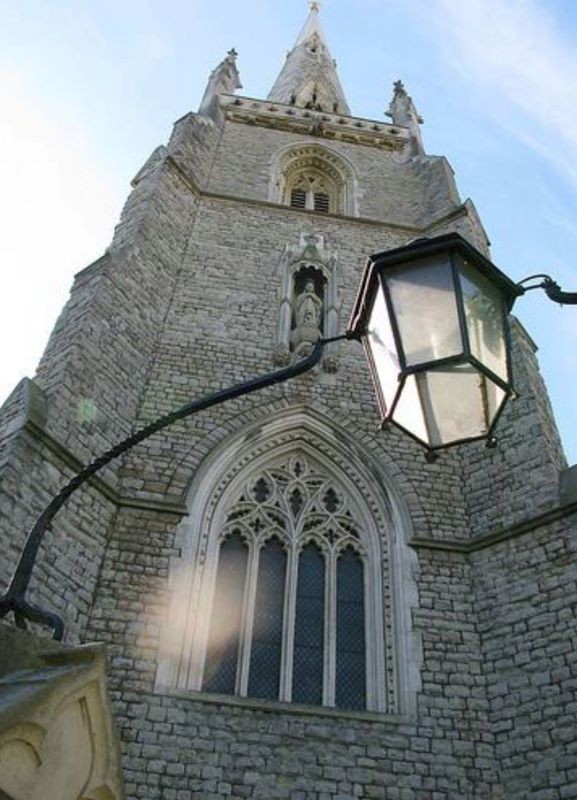
The church is built on a small plot of presbytery land and is largely of Kentish Ragstone with Caen dressings. Ragstone is prone to pollution and environmental decay. Areas of re-pointing to masonry have not always been successful, while other areas have been ‘repaired’ using render to mimic Caen dressings, which can accelerate freeze and thaw decay. It is not built on traditional liturgical lines, with the main east window facing west.
The square tower has three corner buttresses terminating in ornamental crocketed finials. The north-eastern corner has a polygonal stone stair turret, topped with a spire and iron cross finial. At the top of the tower is an open stone tracery parapet from which rises the 150ft (46m) spire in dressed stone. The roofs are welsh slate.
There is a Sanctus bell-cot over the eastern gable of the nave. Since the nave roof repairs of 2001 this bell does not function. In 1851, it was reported that the whole of the exterior stonework was ornamented with the beautiful ball flower. There are not so many now, but quite a few remain.
Peregrines
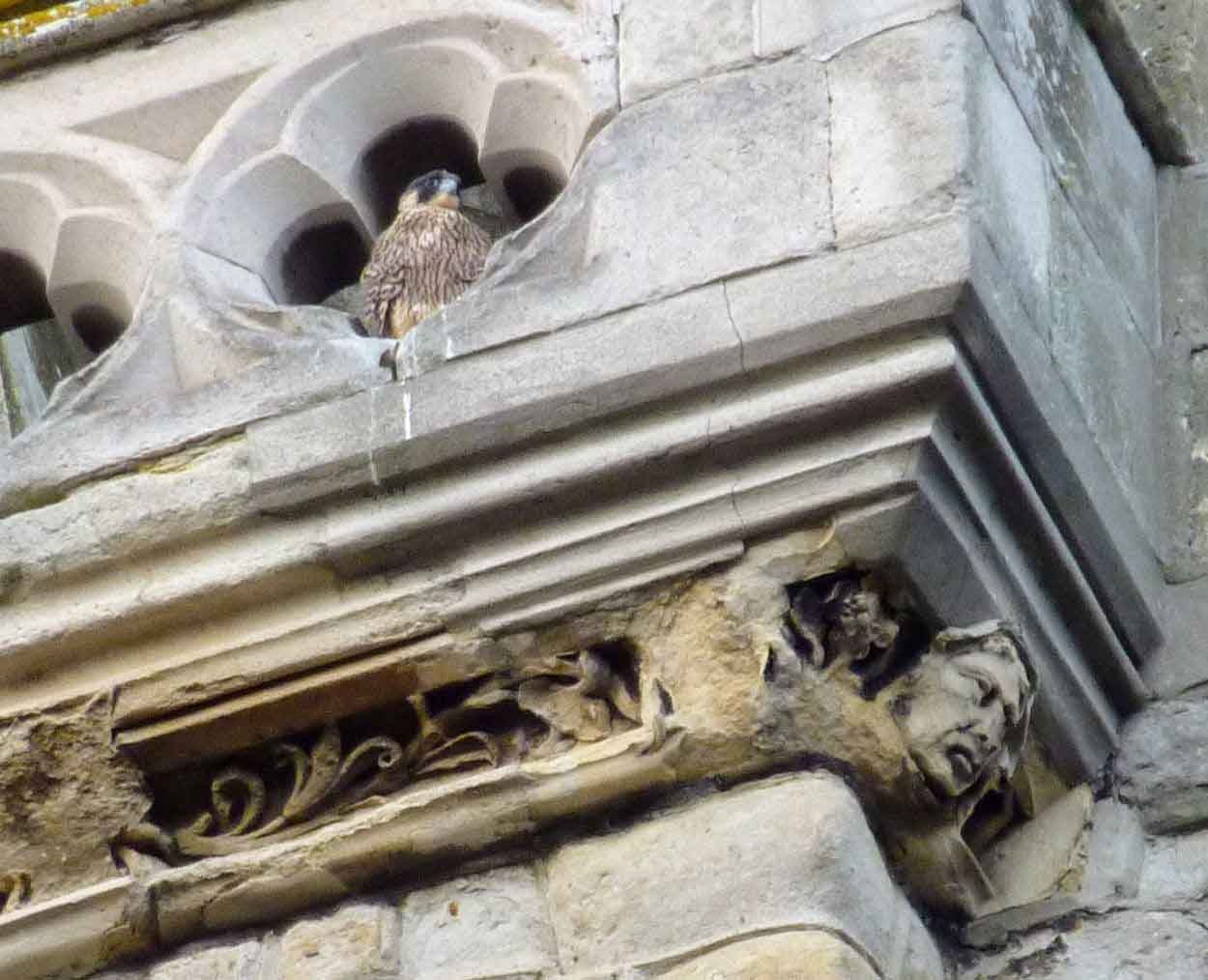
In 2022, there was a family of peregrines nesting on the parapet, sheltering in the turret doorway. Three fledged successfully, though a couple of them had the misfortune of falling through the open quatrefoils to the ground before learning to fly properly. Luckily they were unharmed and were returned to their nest. But this insecurity may have been the reason why they have never returned since to set up home at Our Ladye Star of the Sea. Bird enthusiasts took amazing photos from the high viewpoint in Greenwich park of the birds perching on the cross and spire, and catching green parakeets as prey, mid-flight.
West Greenwich Conservation Area Appraisal published in 2013, refers to Crooms Hill as being “justly regarded as one of London’s most significant and historic residential streets”. Geographically, the site is located on the western edge of Greenwich Park with the road rising up to the south. The church is situated approximately half a mile from the River Thames.
The lantern over the gateway
The wrought iron overthrow with lampholder across the main entrance was restored in 2015, in memory of Frances Curran, a long-standing and much-loved member of this congregation. It is the original lantern for the church. Looking carefully at a close-up of the old 1850s photograph, it can just be seen above the gateway. It was restored with modern LED internals since most of the glass was missing, and given new bevelled-edge glass panels. The frame was straightened and re-plated. It now automatically lights the steps leading up to the church as darkness falls.