The interior
A number of interesting details of our church can be discovered in a visit.

A number of interesting details of our church can be discovered in a visit.
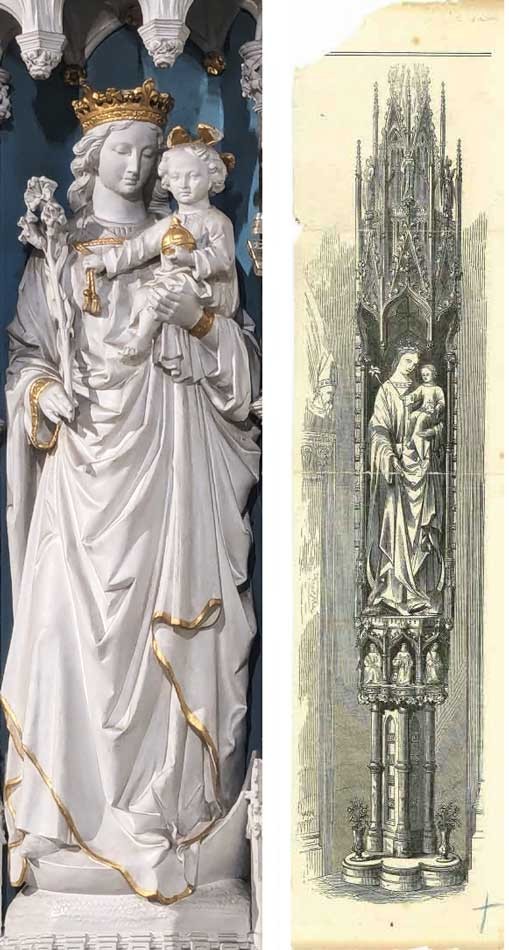
Outside the altar rails is a stone statue of the Virgin with child, designed by AWN Pugin and carved by George Myers. It is situated to the left of the arch in a large niche within a pinnacled canopy.
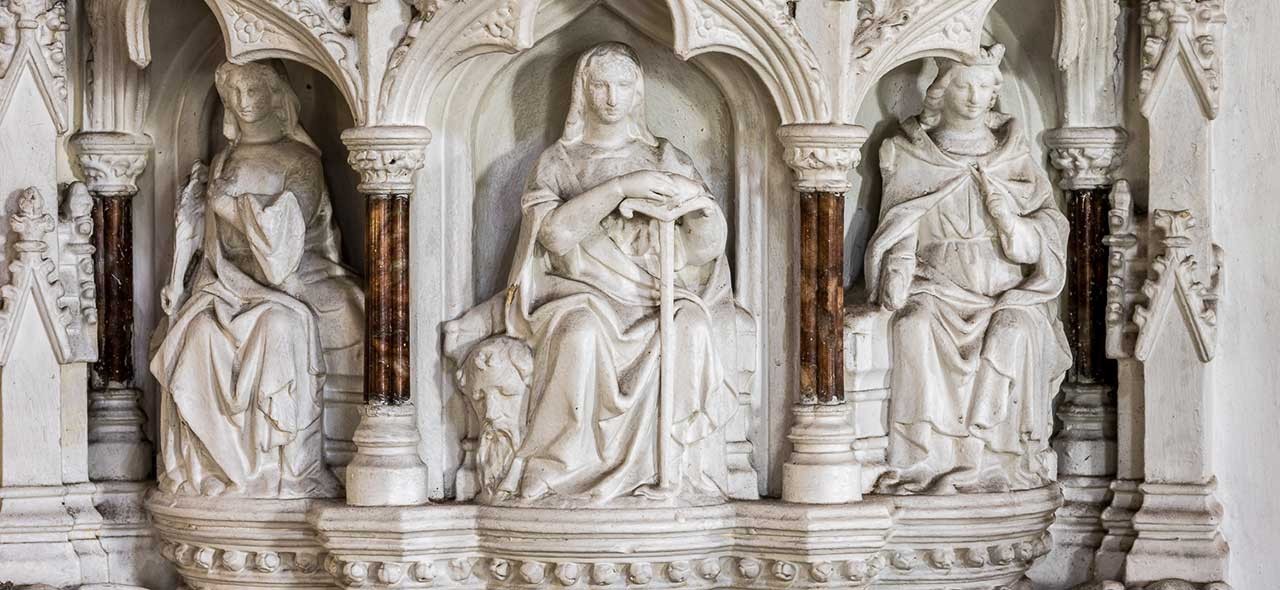
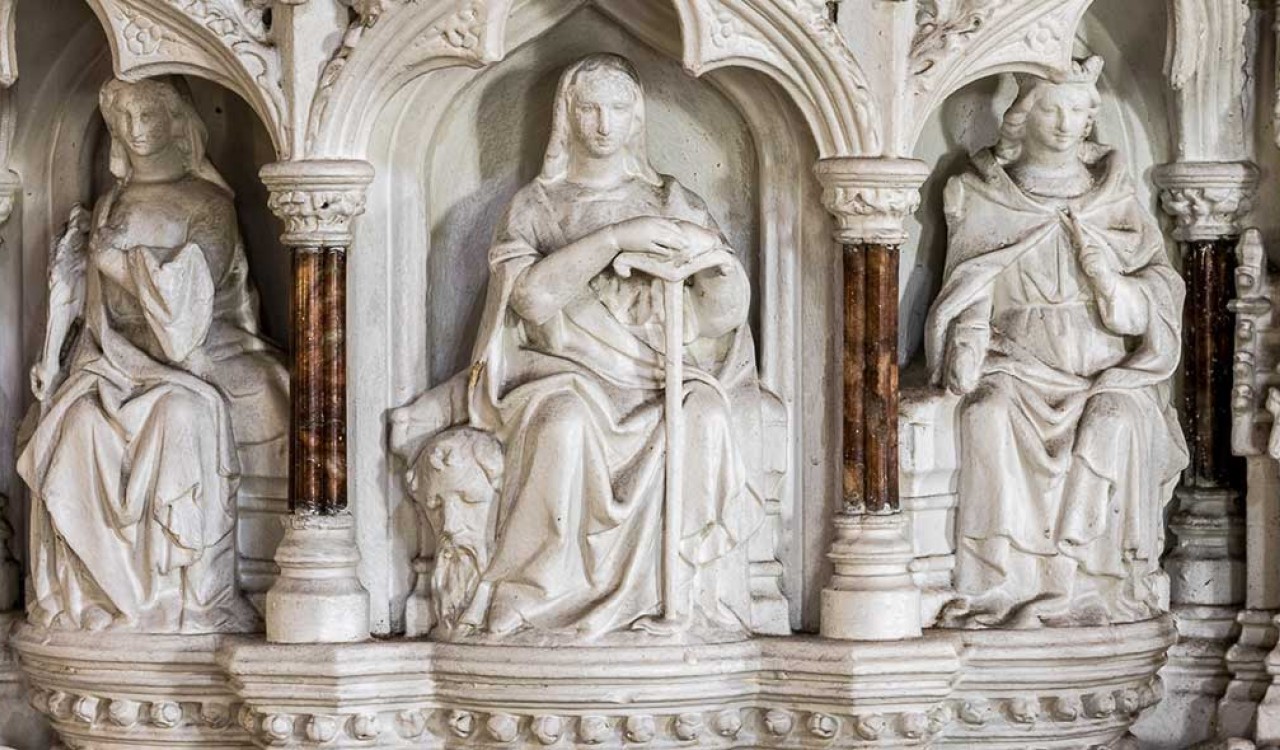
Supporting Our Ladye, the three strong female figures from the Old Testament – seated statues of Ruth, Judith and Queen Esther, all of whom prefigure Mary, are very finely carved (see above). Ruth is shown with a sheaf of corn, Judith with the head of Holofernes, and Queen Esther wearing her crown and gesturing, as if speaking wisely to her king.
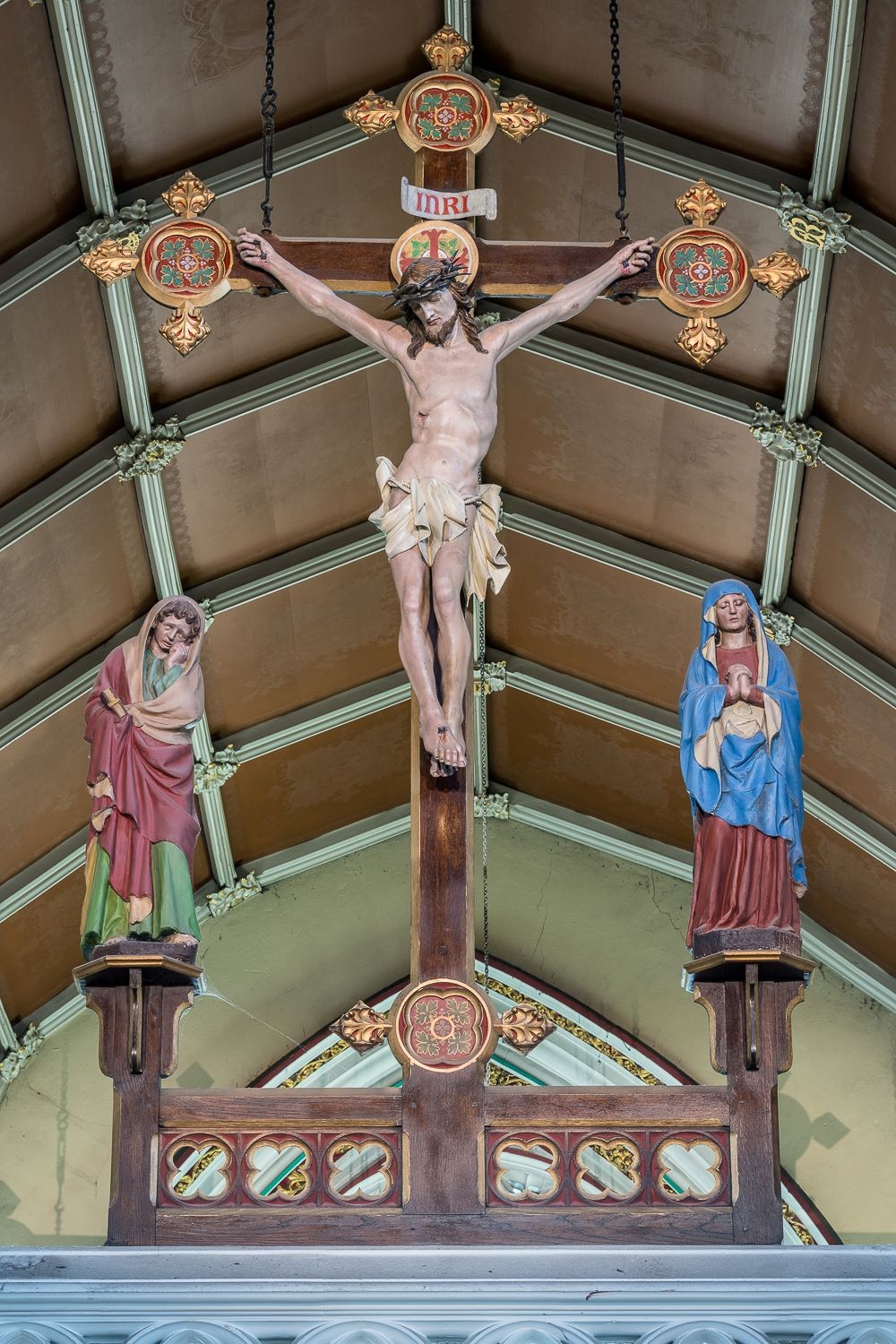
Rood is derived from the Saxon rood or rode, meaning cross. The ornate partition between the chancel and nave, is surmounted by the Rood, a sculptural representation of the Crucifixion.
The rood screen is by Augustus Pugin, made of Caen stone, with marble columns supporting three arches.
Above is the carved oak rood, with St John and Our Lady either side. Currently, the two figures are the wrong way round. It is traditional for Our Lady to be on the left, as can be seen in the 1901 image. It seems likely that changeover happened in 1965, when perhaps the statues were removed while the chancel ceiling was being painted brown and the painting of the Coronation of Our Lady was being painted over.
Pugin advocated and campaigned for the reintroduction of rood screens in Catholic churches, the screen here is believed to be one of only four surviving Pugin screens. St Alban's Macclesfield, St Giles Cheadle and Our Lady and St Alphonsus, Blackmore Park have screens still, too.
The Corpus (body of Christ) is understood to be one of only 20 produced from a design by Pugin in 1847. It is carved by craftsmen employed by George Myers, with whom Pugin collaborated extensively. There was a requirement to strictly adhere to the design, but each artisan had liberty when it came to the girdle, whether to include a belt, or a rope.
Seventeen of the Corpuses were sent to Tasmania for the newly appointed Bishop of Hobart, Bishop Willson. Of the other three, one is at St. Augustine’s in Fulham, one at the old Presentation Convent Chapel in Waterford, (now deconsecrated and is a health centre) and the third is in our church.
It is believed to have been carved in three pieces, the arms separately attached, a separate crown of thorns.
The corpus has:
At St Giles, Cheadle, the arms can be seen as more horizontal than here at Our Ladye Star of the Sea where they are at 45 degrees.
Our corpus is the only one still complete and intact. All the others that are left have lost their crowns.
Something which cannot be seen at Our Ladye Star of the Sea is the hidden painting. The Coronation of The Virgin by Enrico Casolani is on the wall above, and to the sides of the chancel arch. Once much admired, it was sadly obliterated during the 1960s. This deserves investigation as the overpainted canvas remains in place. see the photo from 1901 showing stencils and outline of the painting, We know from Pugin’s letters that it was painted in Ramsgate, in Pugin’s studio. In 1965, the painting was covered with, what is thought to be, masonry paint. This is at the same time that the Chancel’s decorative ceiling was covered with brown paint. Of Casolani’s painting, North wrote to Pugin on the 15 Sept 1851: “It is indeed very beautiful, my only regret is that thro’ defect of light so much of its beauty is lost”.
Artist and designer, Enrico (Henry) Casolani was born in Malta and became a pupil of the Nazarene painter Johann Friedrich Overbeck. He emigrated to England in 1847 and worked briefly as a cartoonist for AWN Pugin. He designed stained-glass windows for James Powell & Sons from 1861 until around 1873 after Pugin’s death.